
Asynchronous Online Master’s in Engineering Management Programs for Working Engineers
 Reviewed by Dr. Luna Magpili, PhD, CPEMPublished: Oct 6, 2026
Key Takeaways
- “Online” and “asynchronous” are not the same thing, so check the school’s own wording before assuming a program has no required live class times.
- Asynchronous courses generally let you choose when to access lectures or course materials and complete weekly work, but assignment and exam deadlines still apply.
- Asynchronous is not the same as self-paced: most graduate courses still run on fixed academic terms with set start and end dates.
- An asynchronous program can still require proctored exams, an orientation, or a campus residency, so delivery format and travel requirements should be checked separately.
- We confirmed 10 online engineering management master’s programs with asynchronous or no-scheduled-meeting-time delivery. Published base tuition ranges from about $20,500 to $43,800 before separately billed fees where applicable.
What “Asynchronous” Actually Means
In an asynchronous course, you do not have to attend a recurring class meeting at a fixed time. Course materials are available for you to access around your schedule, while assignments and other requirements still follow the course calendar. Gonzaga University puts it plainly: its courses are asynchronous, “so you do not have to log on at a certain time to do your coursework.”1
That flexibility has limits. Four terms get mixed up often, so it helps to separate them:
- Asynchronous: No recurring class meeting at a set time; coursework still follows instructor-set deadlines and term dates.
- Synchronous: Classes meet live at scheduled times, usually by video or another real-time platform.
- Mixed or blended: A program combines scheduled live instruction with asynchronous or recorded work.
- Self-paced: You control more of the pace of completion, sometimes within a broader enrollment window. That is different from a fixed-term asynchronous course.
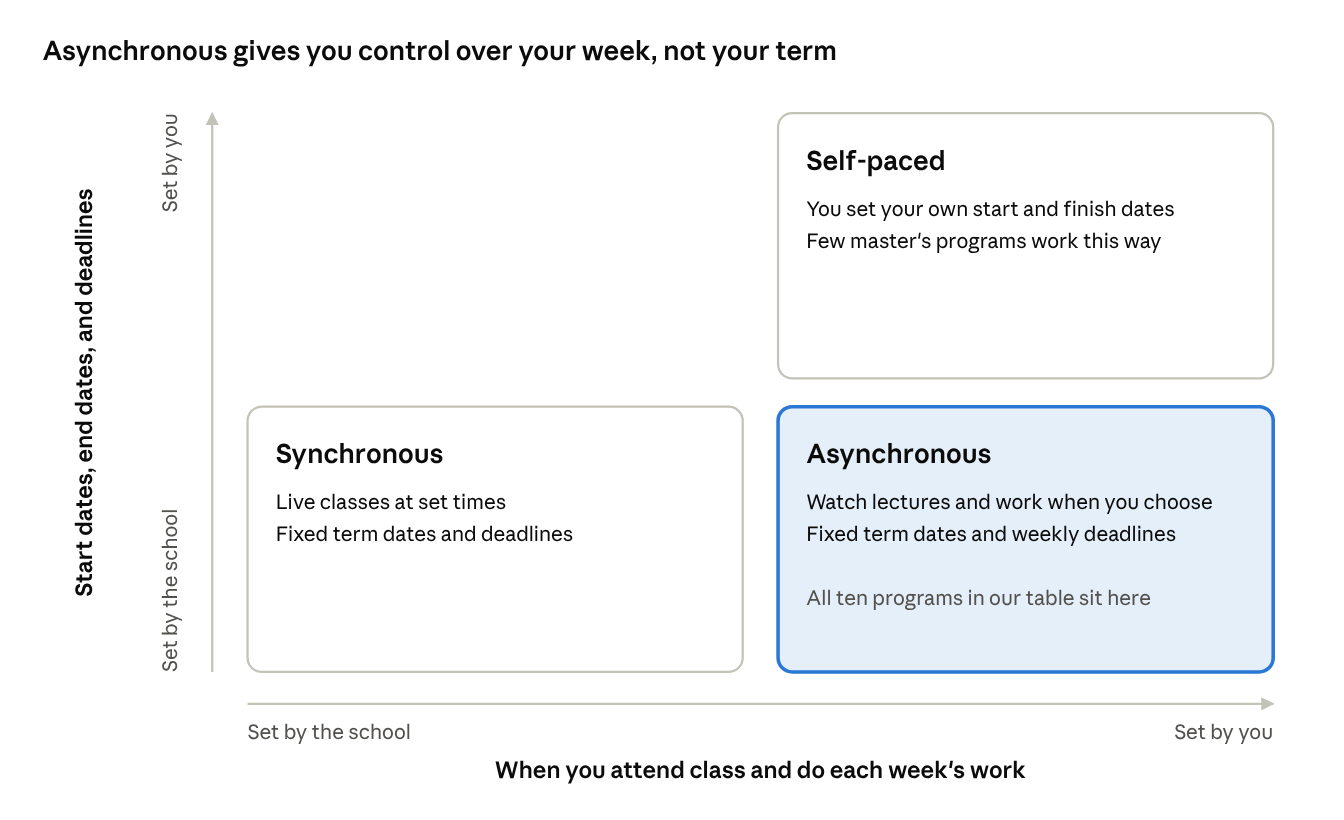
Asynchronous study moves control of your weekly schedule to you, but the school still sets the term and its deadlines.
Even fully asynchronous programs usually have some fixed points in the calendar. The most common are:
- Term dates: Courses start and end on set dates, and at the University of California, Los Angeles (UCLA), each course runs ten weeks.2
- Team projects: Group work may require you to agree on meeting times with classmates in other time zones.
- Office hours: Instructors may hold live help sessions, which are usually optional.
- Exams: At Old Dominion University, for example, instructors “may schedule specific deadlines for assignments or specific times to take exams.”3
Tennessee Technological University puts it this way: students don’t attend at scheduled times, but “the course deliverables are indeed scheduled for submission throughout the semester.”4
Verified Asynchronous MEM Programs
The 10 programs below explicitly describe coursework as asynchronous or state that there are no scheduled meeting times. We started with every online program in our directory of online MEM programs and did not infer asynchronous delivery from “online” or “100% online” alone. Program facts were checked against official university pages through October 6, 2026.
Programs are listed roughly from lower to higher published tuition for nonresident students where residency-based pricing applies. Where a school publishes only a per-credit rate, we multiply it by the required credits. Tuition estimates exclude separately billed fees unless the school explicitly includes them, so they should not be treated as final billed prices.
| Program | Delivery, in the school’s words | Credits | Course length | Typical time to finish | Published tuition estimate | Campus visits and exams |
|---|---|---|---|---|---|---|
| Old Dominion University, Master of Engineering Management3 | “No scheduled meeting times” | 31 | Eight weeks | Not stated | 2026–2027: $662 per credit outside Virginia ($672 for Virginia residents); about $20,522 in tuition. Mandatory online fees are extra.26 | No scheduled class meetings; instructors may set specific exam times |
| University of Nebraska–Lincoln, Master of Engineering Management5 | “100% asynchronous format” | 30 | Eight weeks | As few as five semesters, part time | 2026–2027: $710 per credit, including university fees; about $21,300 total.6 | Optional live sessions may be offered; regular coursework is asynchronous |
| West Virginia University, Master of Science in Engineering Management7 | “Online asynchronous” | 30 | Eight weeks | One year full time; two years part time | $785 per credit for all students; about $23,550 total | Not addressed on the page checked |
| Ohio University, Master of Engineering Management8 | “Asynchronous courses” | 30 | One or two courses per 15-week term | As few as three semesters | $797 per credit ($775 Ohio resident); $23,910 total10 | No residency; courses are “exam free”9 |
| Tennessee Technological University, Master of Science in Engineering Management4 | “All courses are online and asynchronous” | 3311 | Not stated | About two years at two courses per semester, three semesters a year | 2026–2027: $882 per credit for domestic nonresidents ($742 for Tennessee residents); about $29,106 in tuition.12 | Not addressed on the pages checked |
| The Ohio State University, Master of Engineering Management13 | “Can be completed asynchronously” | 30 | Not stated | As few as five semesters full time; about two years is typical | $1,099.88 per credit; about $32,996 in tuition, plus a $100 distance education fee per semester and a $200 nonresident fee per semester.14 | “No campus visits needed” |
| Milwaukee School of Engineering, Master of Science in Engineering Management15 | “Online asynchronous” | 31 | Not stated | Not stated | $1,074 per credit (2026–2027); about $33,294 total16 | Not addressed on the page checked |
| Gonzaga University, Master of Engineering Management17 | “All required classes are asynchronous” | 30 | Eight weeks | Three years part time; three semesters full time | $1,225 per credit (2026–2027); about $36,750 total18 | Not addressed on the pages checked |
| University of California, Los Angeles, Master of Science in Engineering with a Certificate of Specialization in Engineering Management19 | “Asynchronous lectures” | 36 units | Ten weeks, one course per quarter | About two years and one quarter | $1,155 per unit; $41,580 program tuition.19 | Exams are taken in person at UCLA or a local test center; no live class components are required.20 |
| Purdue University, MS/MSE in Interdisciplinary Engineering – Engineering Management Concentration21 | “The courses will be offered asynchronously” | 30 | Not stated | Not stated | $1,459 per credit for nonresidents ($1,139 for Indiana residents); about $43,770 in Purdue tuition before any additional course or program fees.22 | “Exams may require a proctor (virtual or in-person)” |
A few details matter when you compare these rows:
- Degree type: UCLA awards a Master of Science in Engineering with an Engineering Management specialization, while Purdue’s online option is an Engineering Management concentration within its interdisciplinary MS/MSE in engineering. Their degree titles differ from a Master of Engineering Management.
- Residency pricing: Some public universities charge different rates by residency, while others use one online rate. The table shows the nonresident rate first when a residency difference applies.
- Fees: Nebraska–Lincoln’s current $710-per-credit rate includes university fees. Old Dominion adds mandatory online technology and innovation fees, and Ohio State adds semester-based distance education and nonresident fees.
- Rate freshness: Tuition pages can disagree or change midyear. We use the current published rate when a newer university tuition schedule is available and date rates where the school does so.
A program missing from this table isn’t necessarily taught live. Many schools describe their programs only as “online” or “100% online.” Some of those may be fully asynchronous, but we couldn’t confirm it from their own pages. One program our directory had listed as asynchronous, the University of Tennessee, Knoxville’s Master of Science in Engineering Management, describes its delivery as a “mix of asynchronous and synchronous instruction.”23
Disclosure: EngineeringManagement.org may receive compensation from some schools featured on this site. Compensation does not determine which programs appear in this comparison or the order in which they are presented.
No-Campus-Visit vs. Hybrid Requirements
Whether a program is asynchronous and whether it requires travel are separate questions. A program can deliver every lecture on demand and still ask you to come to campus. It can also be fully remote but schedule live sessions. Check both before you apply.
Here are the requirements that most often turn a flexible program into a less flexible one:
- Residencies: Short, required stays on campus, such as the “three weeklong on-campus residencies” in Duke University’s online Master of Engineering Management.24
- Orientations or intensives: Some programs start with an in-person or live virtual kickoff.
- Proctored or on-site exams: A program may require supervised exams even when regular classes are asynchronous. UCLA, for example, requires exams to be taken in person at UCLA or at a local test center.20
- Comprehensive exams or capstone presentations: A final exam or project defense may happen live, even when regular courses don’t.
Some schools are explicit about travel. Ohio University says no residency is required and describes its courses as exam free.9 The Ohio State University says no campus visits are needed.13 UCLA requires in-person proctored exams but allows students to use a local test center rather than travel to Los Angeles.20 Many other program pages do not address travel or exam logistics. When a page is silent, confirm the requirement with admissions rather than assuming there is none.
Duke’s model also shows that “hybrid” can mean different things. Its courses are recorded and “accessible for synchronous and asynchronous viewing,” so you can watch live or later.24 The residencies are what make the program hybrid. For a working engineer, that means planning for three weeks of travel and time off, not rearranging your weekly schedule.
How to Evaluate Flexibility While Working
The label “asynchronous” tells you where to start, not what your week will look like. Workload matters as much as scheduling. Gonzaga, for example, tells applicants that, depending on the class, they “will likely need 10 to 15 hours a week” for coursework.17
Course length changes the math too. An eight-week course often fits a full course into half a semester, so each week is usually denser. Colorado School of Mines, for example, tells online students to expect “16-weeks of work within an 8-week timeframe.”25
Before you enroll, ask admissions these questions:
- Are any course sessions, office hours, or team meetings required at a set time, and in which time zone?
- How many courses do most working students take at once, and how many hours a week do they report?
- Are there proctored exams, and where and when do students take them?
- Is there a required orientation, residency, or on-campus event at any point in the program?
- How much of the coursework is team-based, and how do online teams usually coordinate?
- Can I pause for a term if work gets busy or I have to travel, and is there a limit on total time to finish?
- How is the capstone or comprehensive exam delivered?
Your job matters as much as the program. Think about your travel schedule, busy seasons, and whether your employer’s tuition support requires you to keep a certain pace or grade. If you travel often, ask whether you can download lectures to watch offline and which time zone governs deadlines. For more on balancing work and graduate study, see our guide to part-time master’s programs in engineering management.
Who Asynchronous Study Fits — and Who May Prefer Live Classes
Asynchronous study is not inherently easier than live study. The academic expectations remain graduate-level; the main difference is when you engage with course material and classmates.
Asynchronous programs tend to suit engineers who:
- Work shifts, travel often, or have on-call duties that make fixed class times hard to keep.
- Live in a time zone far from the university.
- Already plan their own work well and don’t need a set class time to stay on track.
- Have family commitments at the hours when live classes usually meet.
Live or blended classes may be a better fit if you:
- Learn best by asking questions and hearing answers in real time.
- Want to build relationships with classmates and faculty through regular face time.
- Find that a fixed weekly class keeps you from falling behind.
- Value networking enough to make room for residencies or campus events.
Many students land in between. A program whose classes you can watch live or later, like Duke’s, lets you attend live when you can and catch up when you can’t.24 If networking matters to you but travel doesn’t work, ask asynchronous programs how they connect online students with classmates and alumni.
FAQ
Which Online MEM Programs Confirm Asynchronous or No-Set-Time Delivery?
As of October 2026, 10 programs in our review explicitly confirm asynchronous delivery or no scheduled meeting times: Old Dominion University, the University of Nebraska–Lincoln, West Virginia University, Ohio University, Tennessee Technological University, The Ohio State University, Milwaukee School of Engineering, Gonzaga University, UCLA, and Purdue University. The exact wording varies, so check whether optional live sessions, exams, or other fixed-time requirements apply.
Does Asynchronous Mean I Can Do the Coursework Whenever I Want?
Usually, you can choose when to access course material and complete the work. You still have instructor-set deadlines, fixed term dates, and sometimes scheduled exams or team commitments.
Which Programs Require No Campus Visits?
Ohio University says no residency is required, and The Ohio State University says no campus visits are needed. UCLA requires in-person proctored exams but allows a local test center. Most other programs in the table do not state a blanket no-travel rule on their main pages, so confirm with admissions.
Can Asynchronous MEM Students Still Have Scheduled Exams or Group Projects?
Yes. Some programs use proctored or comprehensive exams, and team projects often mean coordinating times with classmates.
What Should a Full-Time Engineer Ask Admissions About Scheduling?
Ask about required live sessions, time zones, exams, residencies, typical weekly hours, and whether you can pause for a term. See our full list of questions above.
Sources
- Gonzaga University, “Master of Engineering Management”: https://www.gonzaga.edu/school-of-engineering-applied-science/graduate/mem
- University of California, Los Angeles, Samueli School of Engineering, “MS in Engineering Management” brochure (PDF): https://www.msol.ucla.edu/engineering-management/downloads/mse-eng-mgmt-brochure.pdf
- Old Dominion University Online, “Engineering Management Master’s Degree Online”: https://online.odu.edu/academics/programs/engineering-management-masters-degree-online
- Tennessee Technological University, “Masters in Engineering Management FAQs”: https://www.tntech.edu/engineering/graduate/msem/faqs.php
- University of Nebraska–Lincoln Online, “Master of Engineering Management”: https://online.unl.edu/major/graduate/master-engineering-management
- University of Nebraska–Lincoln, “Tuition & Fees — Master of Engineering Management”: https://engineering.unl.edu/mem/tuition-fees/
- WVU Online, “Engineering Management, M.S.”: https://online.wvu.edu/programs/masters-degrees/engineering-management-ms
- Ohio University Online, “Master of Engineering Management”: https://www.ohio.edu/online/programs/graduate/mem
- Ohio University, “FAQs — Online Master of Engineering Management”: https://www.ohio.edu/engineering/ise/academics/graduate-programs/master-science-engineering-management-online/faqs
- Ohio University, “Tuition — Online Master of Engineering Management”: https://www.ohio.edu/engineering/ise/graduate/master-science-engineering-management-online/tuition
- Tennessee Technological University Graduate Catalog, “EMGT-MS Program”: https://grad.catalog.tntech.edu/programs/EMGT-MS
- Tennessee Technological University College of Graduate Studies, “Tuition, Financial Aid, and Assistantships”: https://www.tntech.edu/graduatestudies/admissions/financial.php
- Ohio State Online, “Master of Engineering Management”: https://online.osu.edu/program/mem
- The Ohio State University College of Engineering, “MEM Tuition & Financial Aid”: https://professionals.engineering.osu.edu/mem-tuition-financial-aid
- Milwaukee School of Engineering, “Engineering Management”: https://www.msoe.edu/academics/graduate-degrees/business/engineering-management/
- Milwaukee School of Engineering, “Graduate Tuition”: https://www.msoe.edu/admissions-aid/tuition-fees/graduate-tuition/
- Gonzaga University, “FAQs — Master of Engineering Management”: https://www.gonzaga.edu/school-of-engineering-applied-science/graduate/mem/faq
- Gonzaga University Student Accounts, “Graduate/Doctoral Online Programs”: https://www.gonzaga.edu/admission/tuition-scholarships-aid/student-accounts/tuition-fees/graduate-doctoral-online-programs
- UCLA Samueli MSOL, “MS in Engineering Management”: https://www.msol.ucla.edu/engineering-management/
- UCLA Samueli MSOL, “FAQ — Engineering Management”: https://www.msol.ucla.edu/engineering-management/faq/
- Purdue University College of Engineering Online, “Engineering Management”: https://engineering.purdue.edu/online/programs/masters-degrees/interdisciplinary-engineering/engineering-management
- Purdue University College of Engineering Online, “Master’s in Interdisciplinary Engineering”: https://engineering.purdue.edu/online/programs/masters-degrees/interdisciplinary-engineering
- Vols Online, University of Tennessee, Knoxville, “Online Master of Science in Engineering Management (MS)”: https://volsonline.utk.edu/program/masters/engineering-management-ms/
- Duke University, “Frequently Asked Questions — Online Program”: https://memp.pratt.duke.edu/online/faq
- Colorado School of Mines, “FAQs about the ETM Program”: https://econbus.mines.edu/engineering-technology-management-inperson/faqs-etm-program/
- ODUGlobal, “Graduate Cost”: https://online.odu.edu/cost/graduate-cost
All sources accessed or rechecked between September 28 and October 6, 2026.
More in Education Landscape
View all Education LandscapeIs Engineering Management a Good Degree? Your Comprehensive Guide
A comprehensive guide to whether a Master of Engineering Management is a good degree, covering coursework, skills, careers, salaries, and how to choose a program.
Master of Engineering Management in Michigan: Everything You Need to Know
Explore Michigan's top Master of Engineering Management programs, including formats, costs, curriculum, and career paths for aspiring engineering leaders.
Why Pursue an Online Engineering Management Degree?
Explore why an online engineering management degree is a flexible, cost-effective path to advancing your career in engineering leadership.
Considering a Certificate in Engineering Management
A guide to earning a graduate certificate in engineering management, covering benefits, coursework, admissions, costs, and career paths.
Everything You Need to Know about Master’s in Engineering Management Rankings
Understand how master’s in engineering management rankings work and explore top-rated, cost-effective, accelerated, and high-ROI MEM programs.
Master of Engineering Management in New York: Programs and Career Paths
Explore Master of Engineering Management programs in New York, including admissions requirements, tuition, career outcomes, and notable universities.
Dr. Luna Magpili, PhD, CPEM
Dr. Magpili has been with Washington State University (WSU) since 2013, where she currently serves as Associate Professor and Director of the Engineering and Technology Management Program. She brings extensive international experience as both an educator and consultant, with a strong focus on global development and risk management. Before joining WSU, Dr. Magpili worked as a Program Officer for International Relief and Development, managing relief and development projects worldwide. More recently, she served as a Fulbright Specialist at Ecole Nationale Supérieure des Travaux Publics (ENTSP) in Cameroon, where she developed and taught courses in supply chain management, project management, and digital e-governance. In addition to her teaching and research roles, Dr. Magpili is highly engaged in the academic community. She serves as a panel reviewer for NSF programs, conference track chair for the American Society for Engineering Management (ASEM), and reviewer for multiple scholarly journals, including Engineering Management Review, PLOS ONE, and ASEE Publications. Dr. Magpili is a co-author of the book Operational Risk Management, a widely used reference in academic settings, and has contributed a chapter to the book Cybersecurity for Entrepreneurs. In 2023, she was awarded a Spencer Education Grant to develop and update risk management modules in Loss Prevention and Control. Dr. Magpili is currently collaborating with startups on the application of artificial intelligence and analytics to improve operational efficiency and decision-making.