
Engineering Management vs. Systems Engineering: Which Master’s Degree Fits Your Career?
 Reviewed by Dr. Luna Magpili, PhD, CPEMPublished: Oct 6, 2026
Key Takeaways
- Engineering management master’s programs generally emphasize leading technical people, projects, budgets, and organizations.
- Systems engineering master’s programs generally emphasize defining, designing, integrating, and evaluating complex engineered systems across their life cycles.
- The fields overlap in project management, risk, decision analysis, and systems thinking; systems engineering is also one of ASEM’s 11 engineering management knowledge domains.
- Neither degree is better in general. The stronger fit depends on whether you want broader responsibility for people and organizations, for complex systems, or for both.
- Blended options exist: some engineering management programs offer systems-focused tracks or specializations, and some degrees combine systems and engineering management in the title.
What Each Field Is Designed to Do
The two fields start from different questions. Engineering management asks how to lead the people, resources, projects, and organizations that do technical work. Systems engineering asks how to define, integrate, and manage a complex system so its parts work together across the life cycle.
The American Society for Engineering Management (ASEM) defines engineering management as the “art and science of planning, organizing, allocating resources, and directing and controlling activities that have a technological or systems component.”1 Its Engineering Management Body of Knowledge (EMBoK) organizes the field into 11 domains, including leadership, strategic planning, financial resource management, project management, quality, operations and supply chain, technology management, systems engineering, law, and ethics.2 For a broader introduction, see What Is Engineering Management? and our guide to the Engineering Management Body of Knowledge.
The International Council on Systems Engineering (INCOSE) defines systems engineering as a transdisciplinary, integrative approach for realizing, using, and retiring engineered systems through systems principles plus scientific, technological, and management methods.3 INCOSE defines a system as “a set of elements that work together to produce results that the individual elements couldn’t achieve alone.”3 The field applies to engineered systems broadly, not only to information technology.
Where They Overlap
The overlap is real. Systems engineering is Domain 9 in ASEM’s current EMBoK.2 ASEM’s Engineering Management Handbook, 3rd Edition describes systems engineering as a practical tool engineering managers can use to:4
- Integrate and balance the work of different engineering disciplines.
- Align each discipline’s technical work with the business or mission goals for the system.
- Translate engineering needs and results for people outside engineering.
INCOSE also includes management methods in its systems engineering definition.3 In practice, both fields use project management, risk analysis, decision analysis, and systems thinking. The emphasis differs: engineering management centers more on people, resources, organizations, and technical execution, while systems engineering centers more on the system and its life cycle.
Curriculum Comparison
ABET’s 2026–2027 program criteria provide a useful benchmark for engineering programs seeking accreditation under engineering management or systems engineering titles.5 They are not a claim that every master’s program in either field is ABET-accredited; rather, they show the curricular topics ABET expects when those program criteria apply.
| Topic area | Engineering management (ABET program criteria) | Systems engineering (ABET program criteria) |
|---|---|---|
| People and organizations | Management of technical personnel, projects, and organizations | Not listed as a separate required topic |
| Projects and technology | Management topics such as project management, technology management, team building, and strategy | System definition, synthesis, analysis, design, and evaluation across the life cycle |
| Financial resources | Engineering economics, accounting, estimating, or finance | Not listed as a separate required topic |
| Analysis and modeling | Decision modeling in a stochastic world, including examples such as simulation and operations research | Decision, risk, and trade-off analysis; optimization; model-based engineering; simulation; sensitivity analysis; or requirements engineering |
| Math and computing | No additional program-specific math requirement beyond the general engineering criteria | Advanced mathematics, including probability and statistics, plus computing fundamentals |
| System design | No separate program-specific systems-design requirement | Define, synthesize, analyze, design, and evaluate complex systems with hardware, software, and human elements where appropriate |
The criteria point to different emphases rather than a simple technical-versus-managerial divide. Engineering management adds explicit responsibility for technical people, organizations, financial resources, and management decisions. Systems engineering adds explicit depth in advanced math, system definition and design, life-cycle integration, and technical trade-off analysis.
University programs follow the same pattern. Because no single school defines the field, we checked five systems engineering master’s programs on their own pages:
| Program | Format | Required core |
|---|---|---|
| Johns Hopkins University, Master of Science in Systems Engineering6 | Online, part time | Introduction to systems engineering, management of systems projects, software systems engineering, system conceptual design, system design and integration, system test and evaluation, and a project or thesis |
| Stevens Institute of Technology, Master of Engineering in Systems Engineering7 | On campus and online | Modeling and simulation or decision and risk analysis, project management of complex systems, fundamentals of systems engineering, and three courses in architecture, implementation, and sustainment |
| University of Southern California, Master of Science in Systems Architecting and Engineering8 | On campus or online via DEN@Viterbi | Engineering economics, systems engineering theory and practice, advanced topics in systems engineering, model-based systems architecting and engineering, and systems architecting |
| Georgia Institute of Technology, Professional Master’s in Applied Systems Engineering9 | Hybrid, with three campus visits | Six core courses on systems engineering fundamentals, modeling and simulation, SysML, and system design |
| Naval Postgraduate School, Master of Science in Systems Engineering10 | Distance learning | Model-based systems engineering, architecting, design, verification and validation, integration, test and evaluation, and project management |
The sample programs commonly pair systems design and analysis with project management or engineering economics. What they do not generally make the organizing center of the degree is people leadership, finance, and organizational strategy. In the other direction, ASEM treats systems engineering as one of 11 engineering management domains rather than the whole engineering management curriculum.
Career and Role Comparison
A degree doesn’t decide your job title, and plenty of engineers move into either kind of role without one. Still, each degree lines up more naturally with certain kinds of work.
| Role direction | Closer fit | Why |
|---|---|---|
| Engineering manager or department head | Engineering management | Leading people, budgets, and teams is the center of the degree |
| Technical program or project manager | Either, or a blend | Both teach project management; systems engineering adds integration, and engineering management adds finance and leadership |
| Systems engineer | Systems engineering | Requirements, architecture, integration, and testing are the core of the degree |
| Systems architect | Systems engineering | Architecture and model-based design are core courses in several programs |
| Operations, quality, or supply chain leader | Engineering management | These are ASEM EMBoK domains, but not required systems engineering topics |
| Technology strategy or R&D manager | Engineering management | Technology management and strategic planning are EMBoK domains |
Government career data supports the management side of this table. The U.S. Bureau of Labor Statistics (BLS) says architectural and engineering managers “plan, direct, and coordinate activities in the fields of architecture and engineering.”11 The typical path is a bachelor’s degree plus five years or more of related experience, and BLS notes that prospective managers may pursue graduate study in engineering management, technology management, or business administration.11 If you are comparing the business-degree route, see our MBA vs. MEM guide.
The systems engineering side is harder to pin down in government data. The job title “Systems Engineer” appears in O*NET, the U.S. Department of Labor’s occupation database, under “Computer Systems Engineers/Architects,” an IT occupation.12 That’s narrower than INCOSE’s definition, so treat salary or job-count figures for “systems engineers” with care, because they may not describe roles in aerospace, defense, energy, or manufacturing.
Titles also vary by employer. One company’s “systems engineer” designs aircraft architectures, and another’s manages servers. Read job descriptions for the work itself, not the title, before deciding which degree a role calls for.
Which Path Fits Your Goals?
Start with the work, not the degree title. Picture the problems you want to be solving five years from now, then follow that work to the degree built for it.
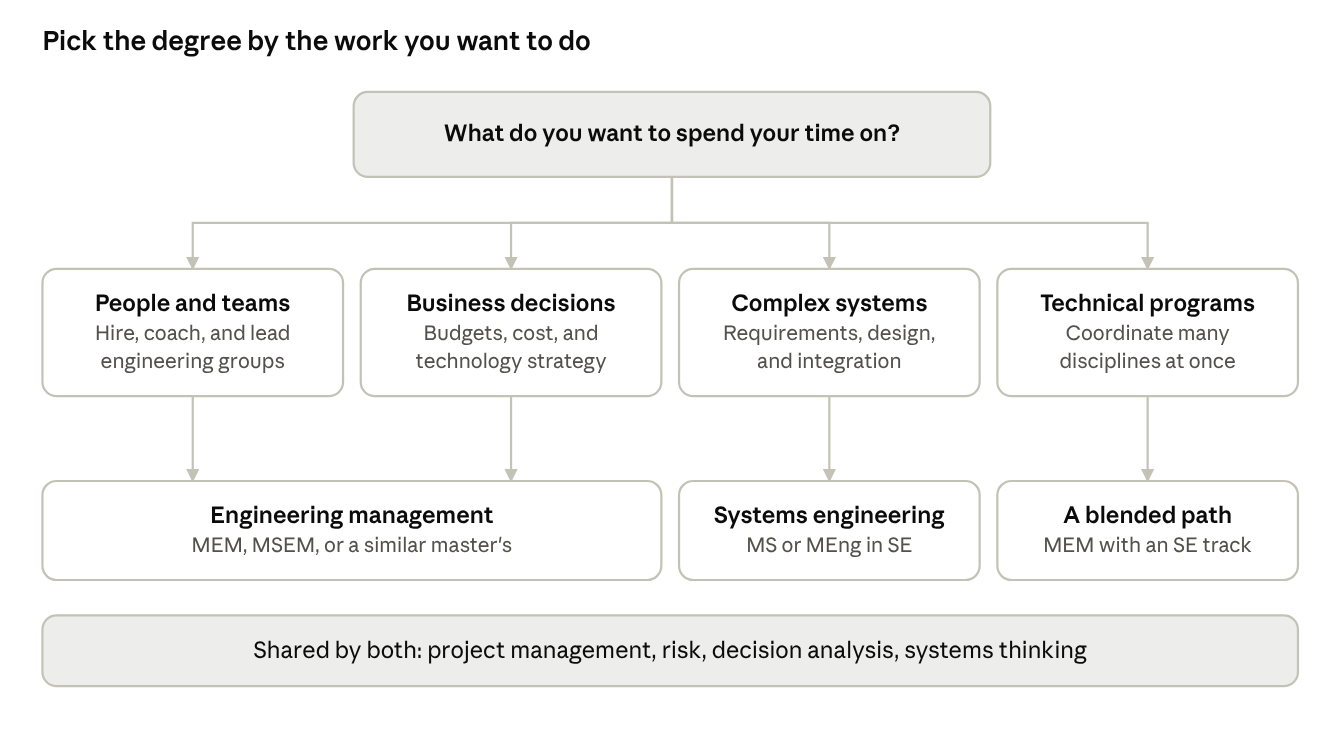
If most of your answer is about people, budgets, or strategy, engineering management is the closer fit. If it’s about how a complex system is defined, built, and tested, systems engineering is. If you want to run large technical programs that cross many disciplines, a blended path may serve you best.
Your background matters too:
- Experienced engineers moving into management may find engineering management especially useful because it targets business, finance, organizational, and leadership skills that may be less central in an engineering bachelor’s curriculum.
- Engineers who already integrate subsystems may find a systems engineering degree formalizes what they do every day.
- Engineers who want to stay technical but take on broader scope can consider either degree, depending on whether that scope is a team or a system.
- Engineers in defense, aerospace, or other systems-heavy industries should check whether their employer treats systems engineering as its own career track before choosing.
Hybrid Options
You don’t always have to choose. Several engineering management programs available online include a systems engineering option, specialization, or track, and one current program in our review combines systems and engineering management in the degree title. We confirmed the four examples below on university pages.
| Program | Systems engineering option | Delivery |
|---|---|---|
| Auburn University, Master of Engineering Management13 | Systems Option: Systems Engineering I and Life Cycle Engineering; two additional systems courses can be used as electives and toward a Systems Engineering Graduate Certificate. | On campus or fully online; some online courses may require in-person exam proctoring |
| National University, Master of Science in Engineering Management14 | Systems Engineering specialization with four courses: Introduction to Systems Design, Systems Analysis and Design Evaluation, Advanced System Design, and System Dynamics | Online; four-week courses |
| The Catholic University of America, Master of Science in Engineering Management15 | Project and Systems Engineering Management track, including Project Management, Introduction to Systems Analysis, and Introduction to Systems Engineering Management | Courses are offered on campus or online |
| Texas Tech University, Master of Science in Systems and Engineering Management16 | Systems and engineering management are combined in the degree title and curriculum | Online or on campus; the online option is asynchronous |
Disclosure: EngineeringManagement.org may receive compensation from some schools featured on this site. Compensation does not determine which programs appear in this comparison or the order in which they are presented.
A blended program may fit if you lead technical programs that cross several disciplines, or if you expect to move between systems and management roles. It may also suit engineers whose employers value systems skills but who want the finance and leadership training a systems engineering degree usually leaves out.
Depth varies. Auburn’s Systems Option requires two systems-specific courses and recommends two more for students who want the related graduate certificate; National University requires four systems specialization courses; Texas Tech offers a full combined Systems and Engineering Management degree. A track or specialization can add meaningful systems content without necessarily matching the breadth of a dedicated systems engineering master’s, so compare required courses before deciding.
FAQ
Is Engineering Management or Systems Engineering More Technical?
Systems engineering generally places more explicit curriculum emphasis on advanced math, requirements, system architecture and design, modeling, integration, verification, and life-cycle analysis. Engineering management retains a technical context but adds explicit management of people and organizations, financial resources, and decision modeling.5
Which Degree Is More Useful for Becoming an Engineering Manager?
Engineering management lines up more directly, because leading technical people and organizations is the core of the degree. BLS also names a master’s in engineering management as one route for prospective engineering managers.11
Can a Systems Engineering Master’s Lead to Leadership Roles?
Yes. Systems engineers often coordinate across disciplines, integrate technical decisions, and lead work that spans requirements, architecture, integration, verification, and risk. ASEM includes systems engineering within the engineering management body of knowledge, and several systems programs also include project management.2 The degree is not primarily organized around people management or budgeting, but it can still support substantial technical leadership.
Do MEM Programs Teach Systems Engineering?
Some do. Systems engineering is one of ASEM’s 11 EMBoK domains, and programs such as Auburn University and National University offer systems engineering concentrations.2,13,14
What If I Want to Stay Technical but Take On Broader Responsibility?
Ask whether that responsibility is for a team or for a system. If it’s a team, engineering management fits better. If it’s a system, systems engineering does. If it’s both, look at a blended program.
Sources
- American Society for Engineering Management, “About ASEM”: https://asem.org/About
- American Society for Engineering Management, “A Guide to the Engineering Management Body of Knowledge”: https://asem.org/EMBoK
- International Council on Systems Engineering, “About Systems Engineering”: https://www.incose.org/about-systems-engineering/
- American Society for Engineering Management, The Engineering Management Handbook, 3rd ed. (2023), Domain 9, “Systems Engineering,” pp. 361–364: https://blog.asem.org/EM-Handbook
- ABET, “Criteria for Accrediting Engineering Programs, 2026–2027”: https://www.abet.org/accreditation/accreditation-criteria/criteria-for-accrediting-engineering-programs-2026-2027/
- Johns Hopkins Engineering for Professionals, “Systems Engineering Courses”: https://ep.jhu.edu/programs/systems-engineering/courses/
- Stevens Institute of Technology, “Systems Engineering Curriculum Overview”: https://www.stevens.edu/systems-engineering-curriculum-overview
- University of Southern California, “Systems Architecting and Engineering” program requirements (PDF): https://academicprograms.usc.edu/wp-content/uploads/2025/07/VITERBI-Systems-Architecting-and-Engineering-7.25.pdf
- Georgia Tech Professional Education, “Professional Master’s in Applied Systems Engineering”: https://pe.gatech.edu/degrees/pmase
- Naval Postgraduate School Online, “Systems Engineering (311)”: https://online.nps.edu/w/311-systems-engineering
- U.S. Bureau of Labor Statistics, “Architectural and Engineering Managers,” Occupational Outlook Handbook: https://www.bls.gov/ooh/management/architectural-and-engineering-managers.htm
- O*NET OnLine, “Computer Systems Engineers/Architects” (15-1299.08): https://www.onetonline.org/link/summary/15-1299.08
- Auburn University Engineering Online, “Master of Engineering Management”: https://eng.auburn.edu/online/program/master-of-engineering-management
- National University, “Master of Science in Engineering Management, Systems Engineering”: https://www.nu.edu/programs/master-of-science-in-engineering-management/master-of-science-in-engineering-management-systems-engineering/
- The Catholic University of America, “Programs in Engineering Management”: https://engineering.catholic.edu/management/programs/index.html
- Texas Tech University, “Master of Science in Systems & Engineering Management”: https://www.depts.ttu.edu/imse/graduate/onlinesystemsengineeringdegree.php
All web sources accessed or rechecked October 6, 2026.
More in Education Landscape
View all Education LandscapeMaster of Engineering Management in California: Explore Top Programs & Career Paths
Discover top Master of Engineering Management programs in California, including on-campus, hybrid, and online options, along with career paths and earning potential.
Finding Your Engineering Management Path in Texas: In-Person & Online Options
Explore Texas engineering management master’s programs, both on-campus and online, with details on tuition, scholarships, and career outcomes.
Accredited Masters in Engineering Management: Your Guide to Top Programs
A guide to ASEM-accredited masters in engineering management programs, covering academic standards, top in-person and online schools, admissions, curriculum, and career outcomes.
Fast-Track or Part-Time? How Long a Master’s in Engineering Really Takes
How long it takes to earn a master’s in engineering, and the factors—format, specialization, and prerequisites—that shape your timeline.
Master of Engineering Management in Indiana: Programs, Careers, and Schools
Explore Indiana's online Master of Engineering Management programs, including formats, costs, admissions, careers, and the state's engineering landscape.
Master of Engineering vs. Master of Science: Choosing the Right Graduate Degree for Your Engineering Career
Compare the Master of Engineering and Master of Science degrees — focus, structure, career paths, featured programs, and how to choose the right fit for your goals.
Dr. Luna Magpili, PhD, CPEM
Dr. Magpili has been with Washington State University (WSU) since 2013, where she currently serves as Associate Professor and Director of the Engineering and Technology Management Program. She brings extensive international experience as both an educator and consultant, with a strong focus on global development and risk management. Before joining WSU, Dr. Magpili worked as a Program Officer for International Relief and Development, managing relief and development projects worldwide. More recently, she served as a Fulbright Specialist at Ecole Nationale Supérieure des Travaux Publics (ENTSP) in Cameroon, where she developed and taught courses in supply chain management, project management, and digital e-governance. In addition to her teaching and research roles, Dr. Magpili is highly engaged in the academic community. She serves as a panel reviewer for NSF programs, conference track chair for the American Society for Engineering Management (ASEM), and reviewer for multiple scholarly journals, including Engineering Management Review, PLOS ONE, and ASEE Publications. Dr. Magpili is a co-author of the book Operational Risk Management, a widely used reference in academic settings, and has contributed a chapter to the book Cybersecurity for Entrepreneurs. In 2023, she was awarded a Spencer Education Grant to develop and update risk management modules in Loss Prevention and Control. Dr. Magpili is currently collaborating with startups on the application of artificial intelligence and analytics to improve operational efficiency and decision-making.